Research

Noncovalent interactions are of paramount importance to chemistry, materials science and biology. Yet most practical simulations still rely on simplistic models, which often fail to capture these interactions accurately in systems of modern interest. My work approaches this challenge from a single angle: build a minimal quantum model of how electrons respond, ask which physical effects really have to be accounted for, and turn the answer into potentials that survive in production simulations. The directions below follow that thread — from the coarse-grained model at its core, through the physics it exposes, to where it runs at scale.

1. Quantum Drude oscillators: a minimal model of electronic response

How far can three numbers {ω, μ, q} go in describing atoms' response to each other?

Most of my work rests on one idea: an atom’s valence electron cloud can be represented as a quantum Drude oscillator (QDO), defined by just a frequency \(\omega\), a mass \(\mu\) and a charge \(q\). The win is that response and interaction properties then follow analytically, without an electronic-structure calculation.

Two results make the model practical. In the optimized QDO (OQDO) parametrization, all three parameters are fixed from only the static dipole polarizability and the \(C_6\) coefficient — giving accurate polarization potentials and multipolar dispersion coefficients across the periodic table. Building on that, I derived a universal pairwise vdW potential whose functional form comes from the QDO model itself and which again needs only \(\alpha_1\) and \(C_6\) per element. It has since been adopted as the long-range module in machine-learned force-field frameworks including SO3LR and FeNNol.

I also led a community review synthesizing what QDO models can and cannot do, written with colleagues across the field.

In progress

I am currently pushing the model into territory it was never built for: covalent bonding. At this stage it is a proof of concept, and its value lies in mapping where the model works and where it genuinely breaks. If successful, this points towards a single coarse-grained framework covering covalent and noncovalent bonding alike.

Key papers: JCP 2025 (review) · JCTC 2023 · JPCL 2023
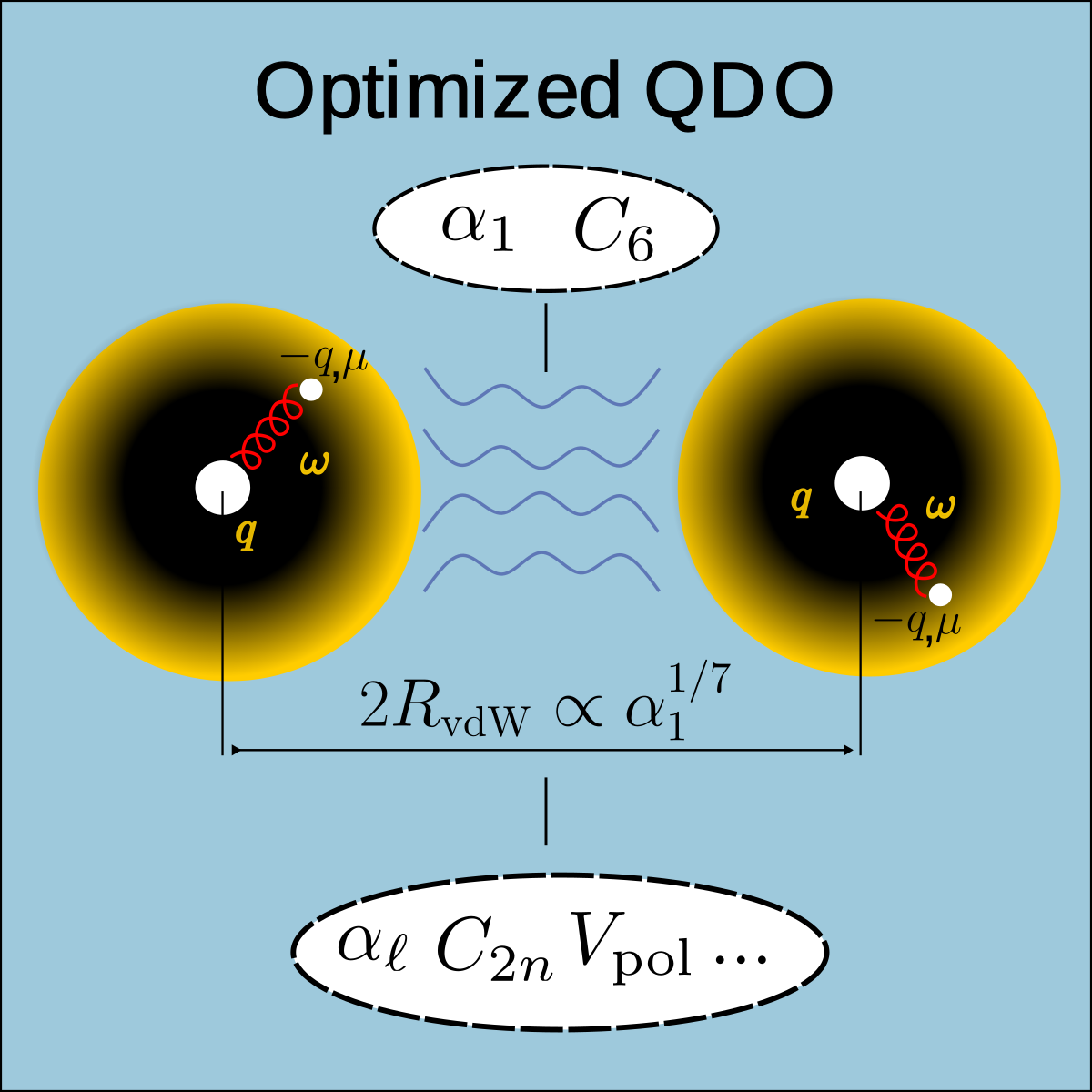
Schematic of two coupled quantum Drude oscillators: a positive pseudo-nucleus harmonically bound to a negative Drude particle, two such atoms separated by a distance R and coupled through the Coulomb interaction Schematic of two coupled quantum Drude oscillators: a positive pseudo-nucleus harmonically bound to a negative Drude particle, two such atoms separated by a distance R and coupled through the Coulomb interaction (enlarged)

Two coupled QDOs and the model parameters. Correlated displacements of the drudons give the dispersion interaction.
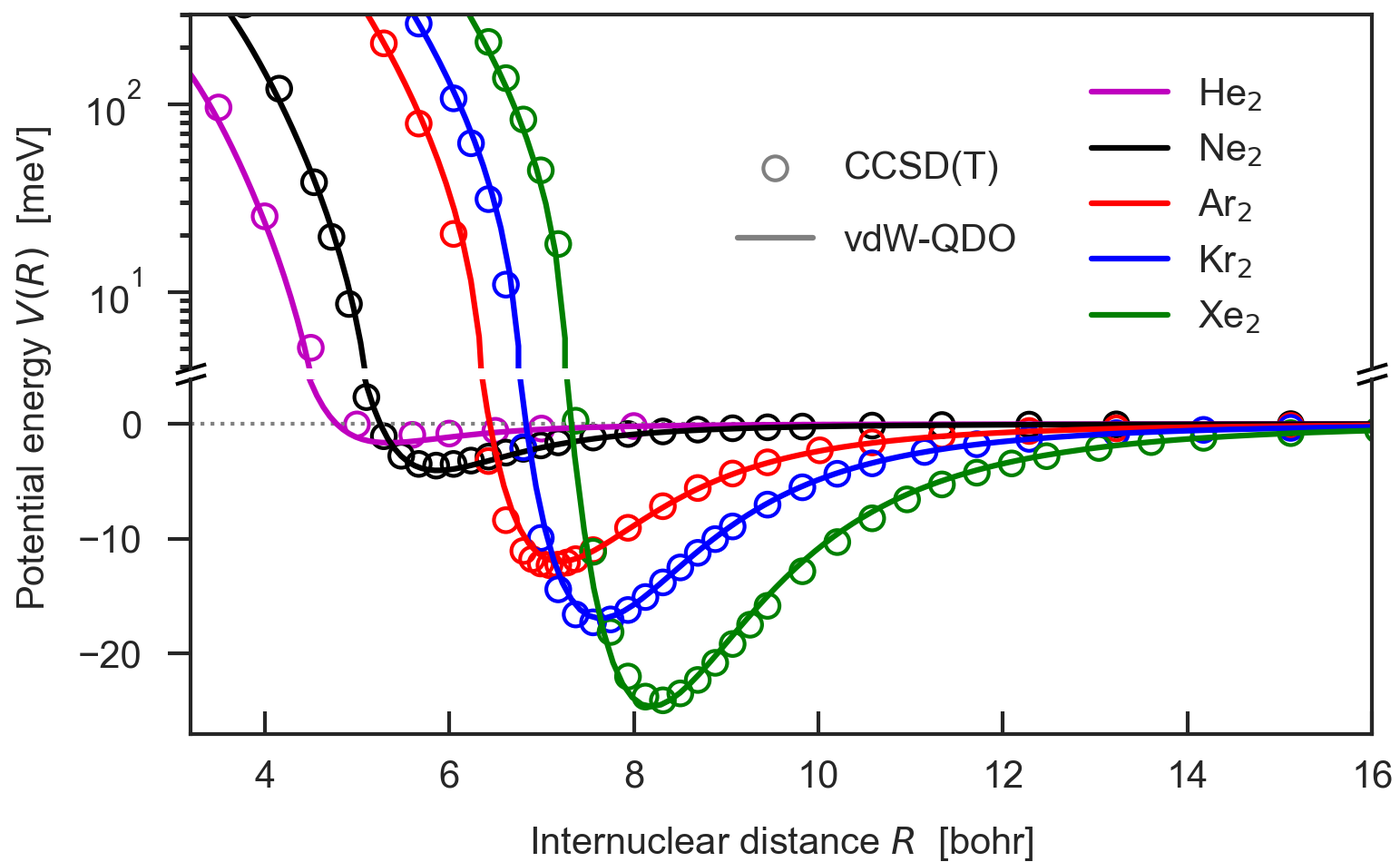
vdW binding curves from the QDO potential vdW binding curves from the QDO potential (enlarged)

vdW binding curves obtained from the QDO model accurately recover the coupled-cluster reference.
2. The fundamental link between dispersion and the electron density

Dispersion is widely regarded as an additive energy correction. However, in large systems it is not that simple — dispersion reshapes the electron density itself.

Density-functional approximations are usually judged on energies, and long-range dispersion is added afterwards as a correction that leaves the density untouched. That is reasonable for small molecules, but not necessarily for large, polarizable systems — exactly the question I studied.

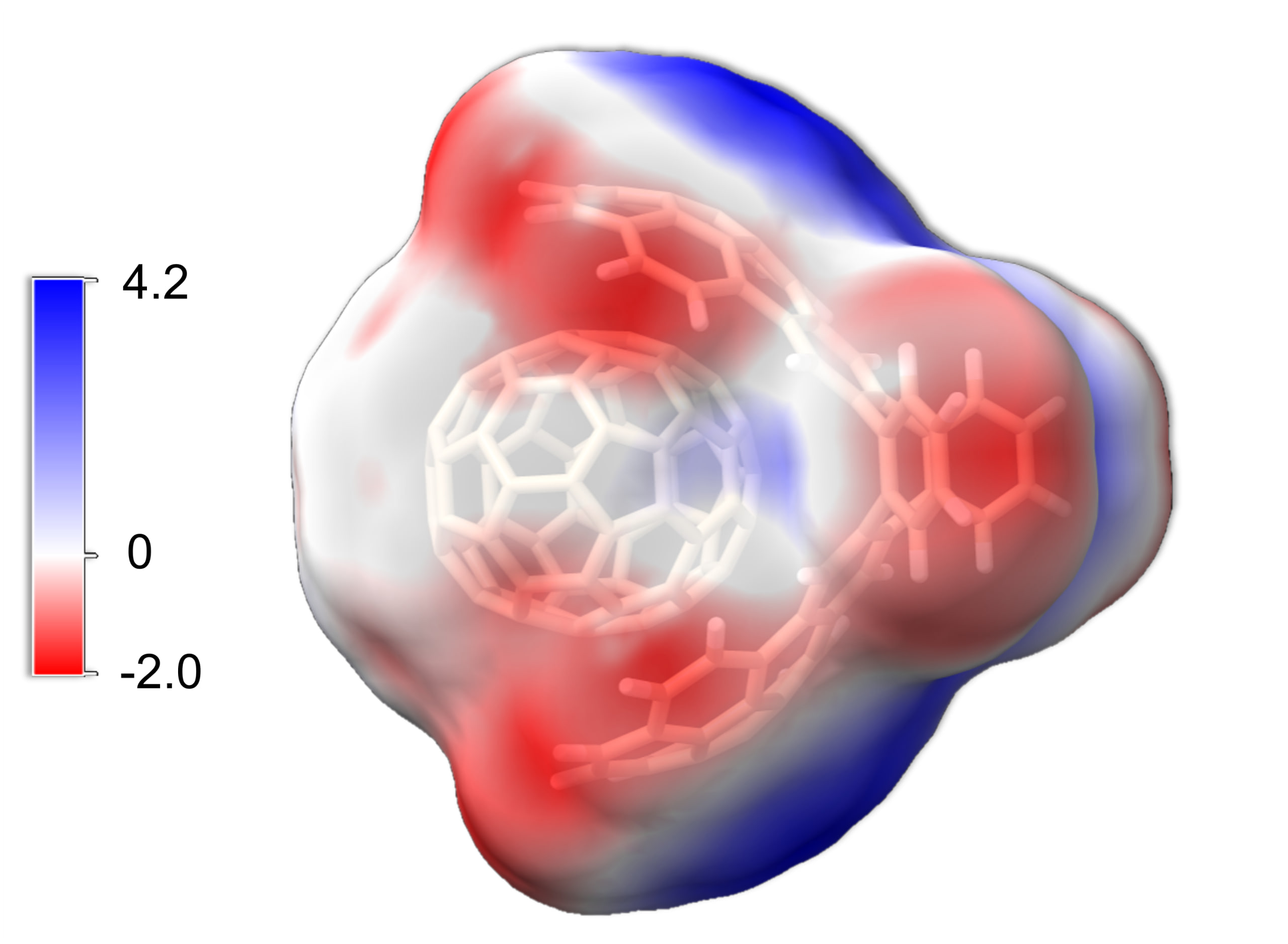
Across more than 30 molecular and supramolecular systems, benchmarked against carefully converged CCSD−HF reference density differences, dispersion turns out to polarize electron densities substantially, shifting long-range electrostatic potentials by up to 4 kcal/mol. That is a non-trivial coupling between dispersion and electrostatics — two contributions that are routinely treated as separable. This has consequences for any density-derived quantity, from electrostatic potentials to density-based bonding indicators.

There is also an uncomfortable implication for the functionals themselves. In the systems where polarization matters most, an exchange–correlation approximation evaluates the energy at a slightly wrong density, and how much that costs in supramolecular complexes and proteins is what I would eventually like to find out. The hard part is disentangling the two contributions: semilocal functionals already capture some dispersion at intermediate range, by an amount that is difficult to pin down, and that overlap is normally hidden inside an empirically fitted damping function.

In progress

I am also developing a reduced-density-matrix formulation of the many-body dispersion (MBD) model, which recasts the dispersion energy as a scalar energy density field rather than a single number. If it works, dispersion stops being one number per system and becomes something you can look at in space, seeing where the dispersion energy sits.

Key papers: JACS 2025 · Dataset (Zenodo)

Dispersion-induced electrostatic potential map Dispersion-induced electrostatic potential map (enlarged)

Map of the dispersion-induced electrostatic potential for the buckyball catcher (in kcal/mol).

2. The fundamental link between dispersion and the electron density 2. The fundamental link between dispersion and the electron density (enlarged)

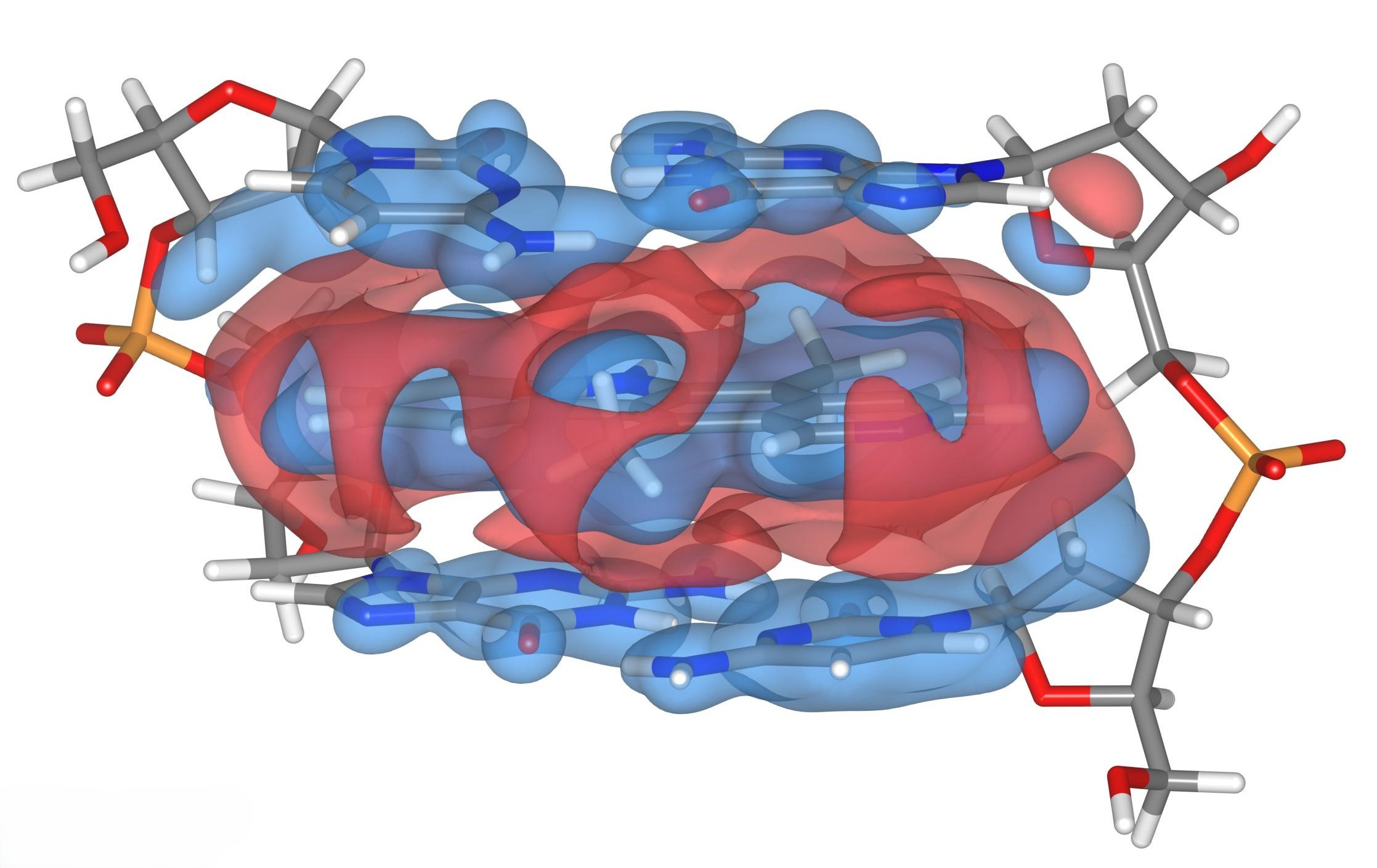
The MBD energy density plotted in real space for the DNA-ellipticine complex.

3. From accurate physics to large-scale simulation

This is where the coarse-grained models above meet production simulations.

Machine-learned force fields have largely solved short-range accuracy, but they inherit a long-standing weakness at long range, where dispersion and electrostatics dominate. Physically grounded, transferable models are the natural fix — and they only need to be derived once.

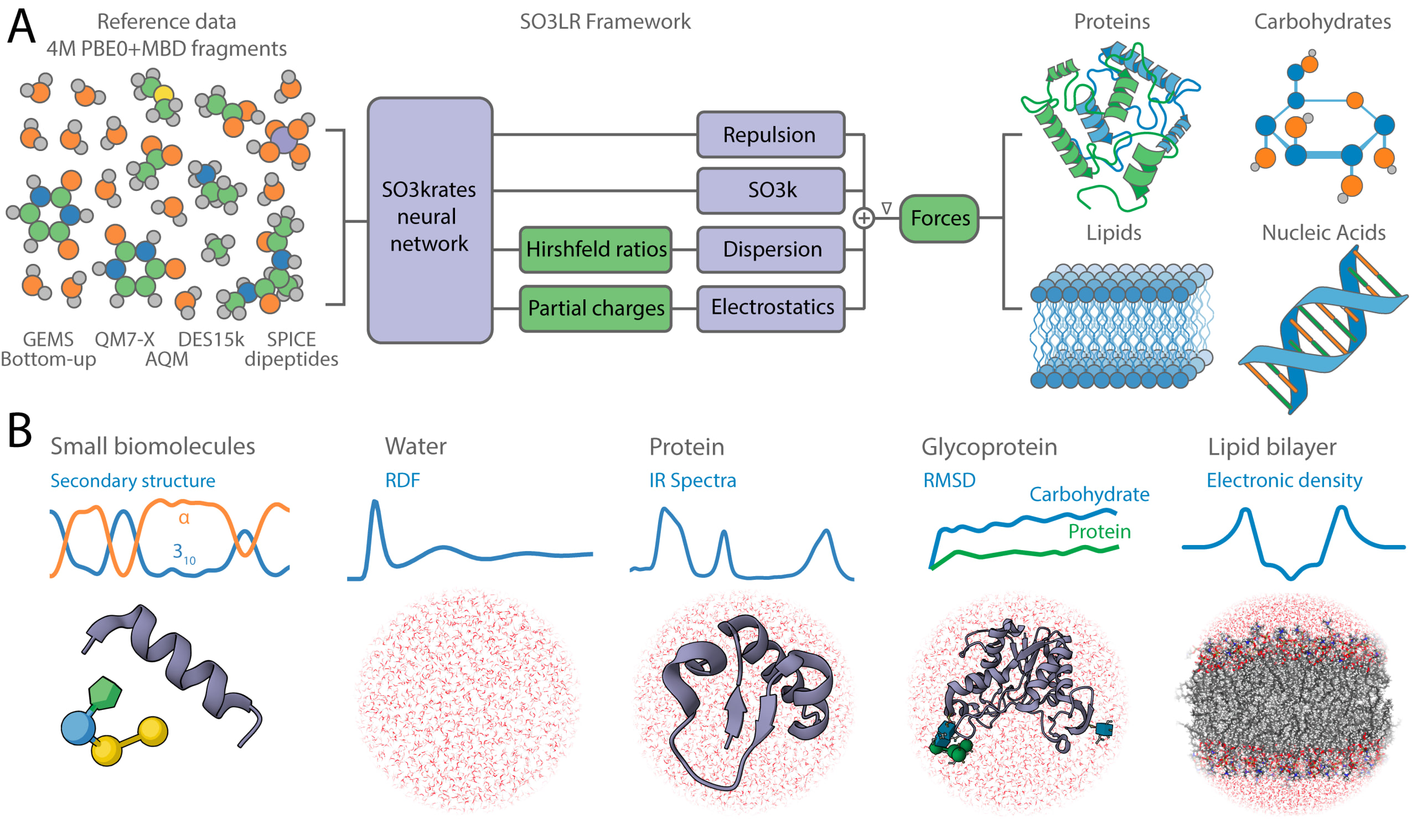
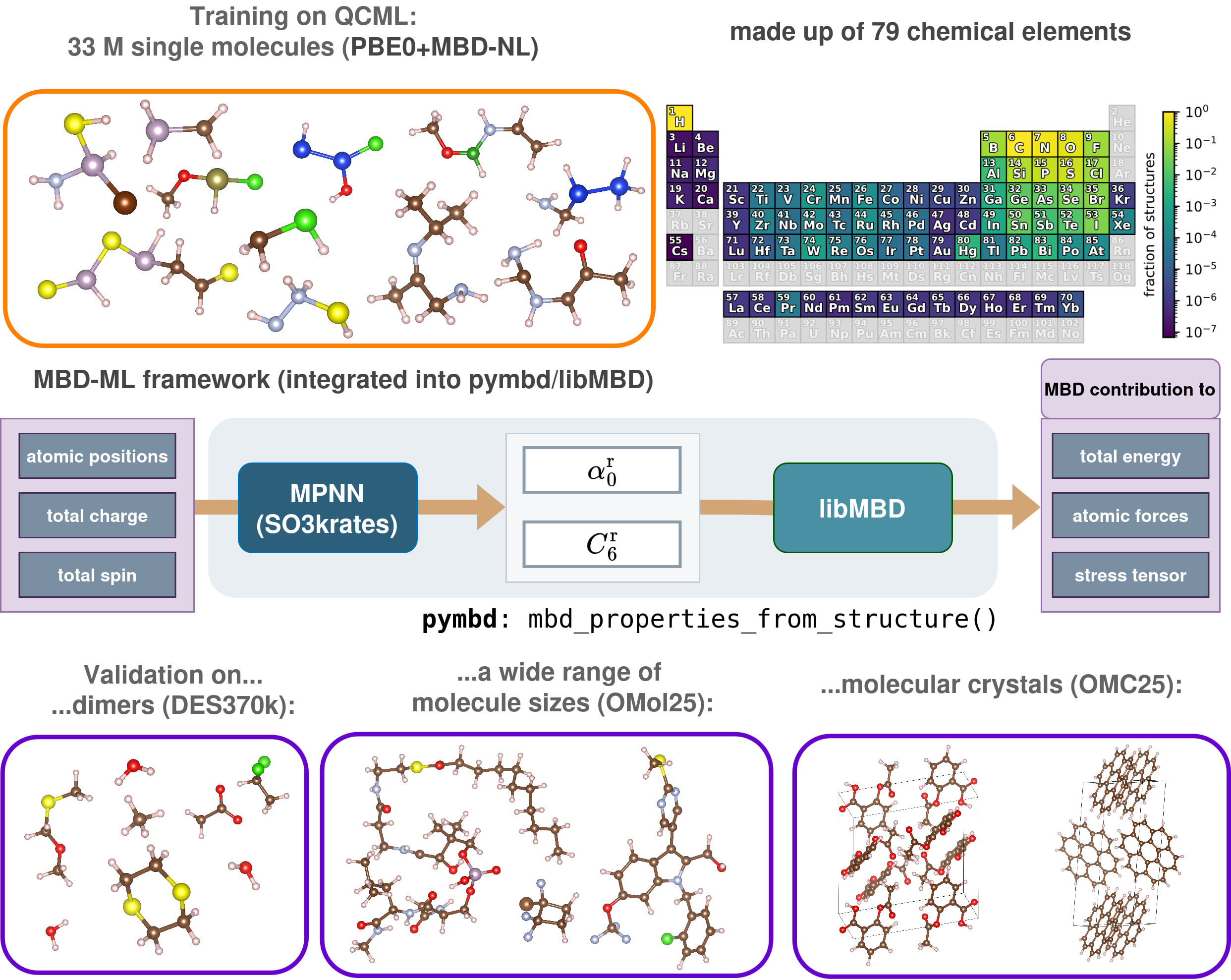
The universal vdW potential from my QDO work serves exactly this role: it is the long-range dispersion module inside SO3LR, which couples the SO3krates neural network for semilocal interactions with universal pairwise terms for short-range repulsion, electrostatics and dispersion, enabling stable simulations of large and diverse biomolecular systems. In MBD-ML, machine learning supplies the inputs that the nonlocal many-body dispersion (MBD-NL) formalism normally requires from an electronic-structure code, freeing one of the most accurate available dispersion treatments from that dependency.

Both are collaborative projects in which I contributed the long-range dispersion component and expertise in physics rather than leading the work — but they are the clearest evidence that the models in the sections above survive contact with real simulations.

In progress

Making ML-based long-range methodologies transferable across chemical space is still an open challenge. Extending them to work reliably across broad classes of materials and hybrid interfaces is one of the directions I intend to pursue.

Key papers: SO3LR · MBD-ML

3. From accurate physics to large-scale simulation 3. From accurate physics to large-scale simulation (enlarged)

Overview of the SO3LR architecture. The long-range modules complement the neural network.

3. From accurate physics to large-scale simulation 3. From accurate physics to large-scale simulation (enlarged)

Overview of the MBD-ML approach. The neural network predicts polarizability and dispersion coefficient ratios, serving as inputs to libMBD.

4. Earlier work: nanoscale carbon and low-dimensional materials

Where I started — density-functional modeling of carbon nanostructures and 2D materials, much of it alongside experiment.

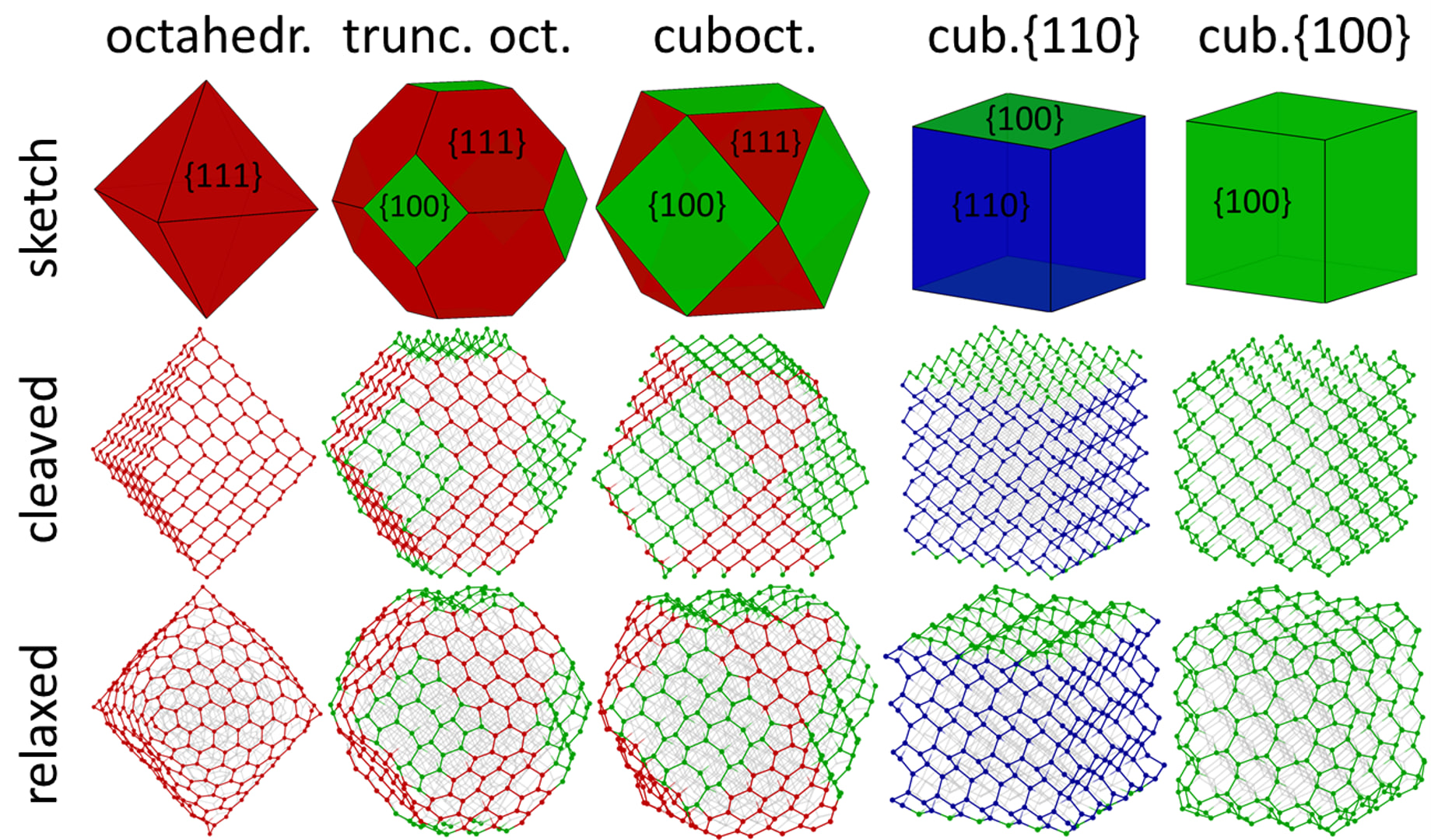
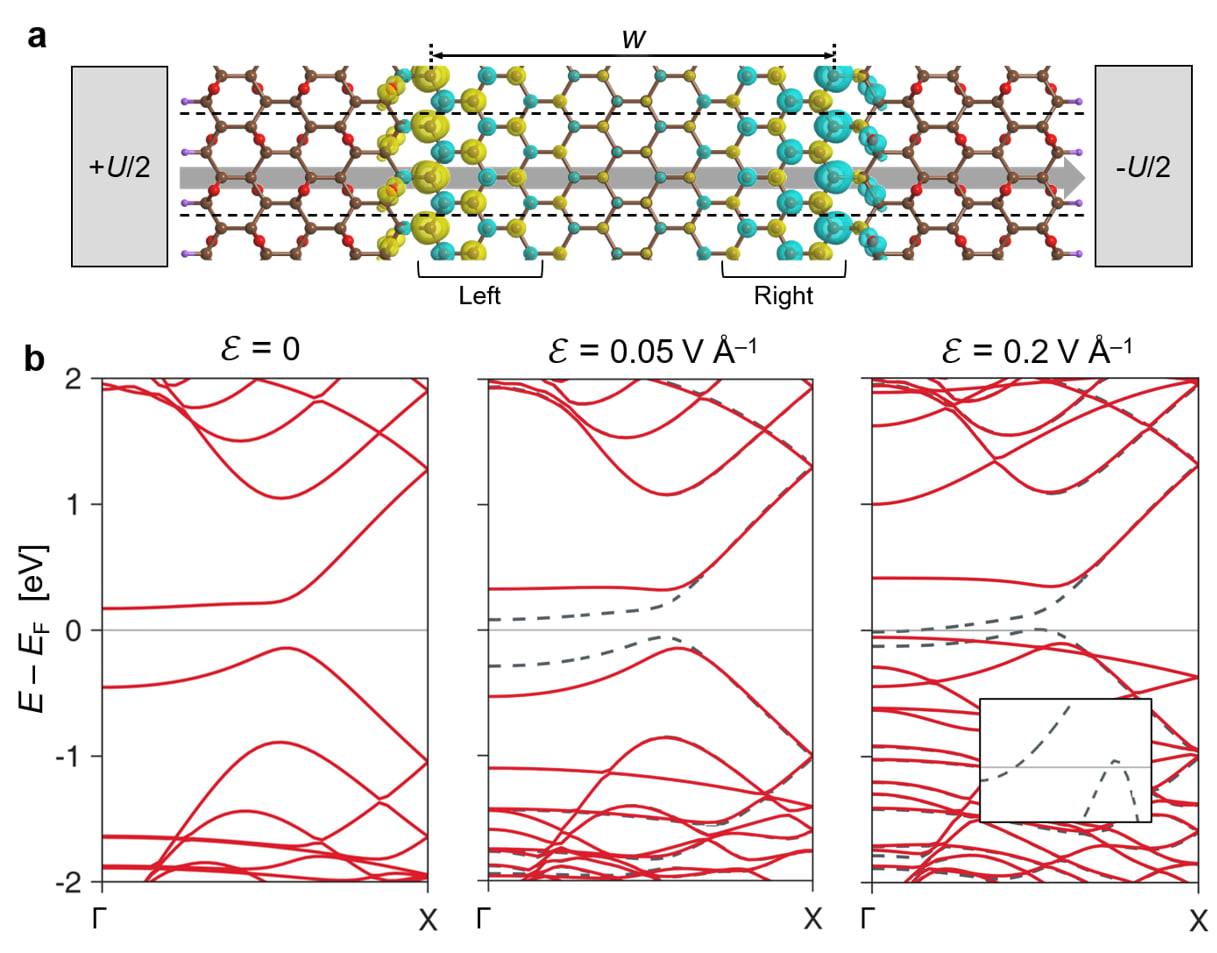
Before moving to noncovalent interactions, I worked on the electronic and mechanical properties of nanomaterials in Moscow. I showed that ultrasmall diamond nanoparticles can be stiffer than bulk diamond depending on their size and shape, and proposed an unambiguous definition of incompressibility at the nanoscale. Separately, I modeled graphene oxide patterned by pristine graphene nanoroads and computed the resulting electronic structure. Several of these projects provided the theoretical counterpart to experimental studies, including h-BN/Al nanocomposite UV photodetectors.

This is not my current direction, but it is where I learned solid-state physics, density-functional theory in practice, and how to work with experimentalists. And who knows, maybe one day I will revisit these topics — with a broader perspective and fresh ideas.

Key papers: Carbon 2020 · Nanoscale 2022

4. Earlier work: nanoscale carbon and low-dimensional materials 4. Earlier work: nanoscale carbon and low-dimensional materials (enlarged)

A zoo of nanodiamonds with low-index surfaces.

4. Earlier work: nanoscale carbon and low-dimensional materials 4. Earlier work: nanoscale carbon and low-dimensional materials (enlarged)

The band structure of the nanoroad paved in graphene oxide: electric field-induced transition from a semiconducting to a half-metallic state.