<?xml version="1.0" encoding="utf-8"?><feed xmlns="http://www.w3.org/2005/Atom" ><generator uri="https://jekyllrb.com/" version="3.10.0">Jekyll</generator><link href="https://almaz-khabibrakhmanov.github.io/feed.xml" rel="self" type="application/atom+xml" /><link href="https://almaz-khabibrakhmanov.github.io/" rel="alternate" type="text/html" /><updated>2026-10-21T15:36:56+00:00</updated><id>https://almaz-khabibrakhmanov.github.io/feed.xml</id><title type="html">Almaz Khabibrakhmanov</title><subtitle>Postdoctoral Researcher, University of Luxembourg — Bridging Quantum Mechanics with Atomistic Simulations</subtitle><author><name>Dr. Almaz Khabibrakhmanov</name><email>aikhabibrakhmanov@gmail.com</email></author><entry><title type="html">Data available for “Noncovalent Interactions in DFT: All the Charge Density We Do Not See”</title><link href="https://almaz-khabibrakhmanov.github.io/posts/2026/03/blog-post-1/" rel="alternate" type="text/html" title="Data available for “Noncovalent Interactions in DFT: All the Charge Density We Do Not See”" /><published>2026-03-14T00:00:00+00:00</published><updated>2026-03-14T00:00:00+00:00</updated><id>https://almaz-khabibrakhmanov.github.io/posts/2026/03/blog-post-1</id><content type="html" xml:base="https://almaz-khabibrakhmanov.github.io/posts/2026/03/blog-post-1/"><![CDATA[<p>1.2 TB of raw data. 21 MB of a scientific paper in PDF. That’s a compression factor of 60,000×!</p>

<p>For a long time, I didn’t bother with publishing research data alongside papers — even though I fully agreed it was important. I think many people can relate: once a paper is accepted, you feel relieved and move on, while the data remain scattered across folders and files that only you can navigate. Cleaning and structuring everything always feels like unnecessary extra work.</p>

<p>This time, I decided to do it properly — helped by a timely request from a colleague who asked for the data.</p>

<p>So I went back to my recent JACS paper on dispersion-induced density polarization and curated the full dataset for publication. Even after just six months, reconstructing the exact data used for the final results was harder than I expected — which is precisely why this matters. But the effort was absolutely worth it: the data are now cleanly structured, documented, and usable.</p>

<p>📍The dataset is now publicly available on <a href="https://doi.org/10.5281/zenodo.18865966">Zenodo</a> and includes volumetric electron density difference maps, electrostatic potentials, NCI analysis data, numerical data used for all figures, as well as example scripts and geometries.</p>

<p>💡 While doing this, I had an interesting realization: writing a scientific paper is essentially an <em>extreme data compression algorithm</em>.</p>

<p>In my case, about 1.2 TB of raw data (including all tests and failed paths) were reduced to 32 GB of curated data behind the production results. To share online, these were further compressed to 9 GB of distributable archives, while the paper and supplement amount to just 21 MB of text and figures. That’s a compression factor of roughly 60,000×!</p>

<p>For comparison, the human genome (~3 billion base pairs) corresponds to roughly 750 MB of information (assuming 2 bits per base), and yet it encodes an entire organism. Science, in its own way, is doing something similar — compressing and structuring vast amounts of raw information into compact, human-readable knowledge.</p>

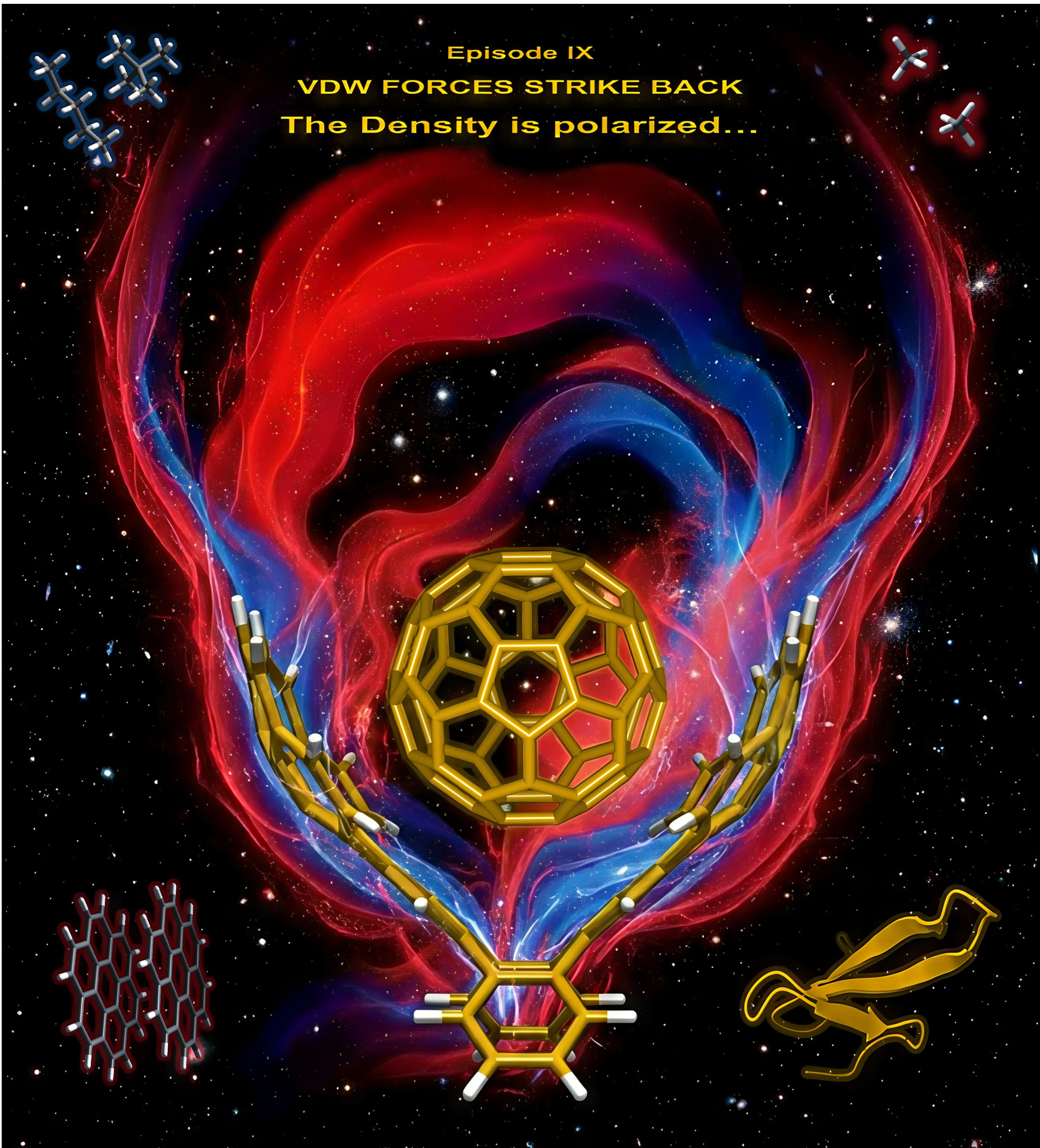
<p>Finally, a bonus: the image below is a cover art proposal I submitted for the paper. It wasn’t selected, but I think it captures the work nicely in an artistic way, so I’m sharing it anyway.</p>

<p><img src="/files/papers/toc_figures/2025-Cover_art_MBD_Density-JACS.png" alt="Cover art proposal for the JACS paper on dispersion-induced density polarization" /></p>]]></content><author><name>Dr. Almaz Khabibrakhmanov</name><email>aikhabibrakhmanov@gmail.com</email></author><category term="dataset" /><category term="vdW dispersion" /><category term="density functional theory" /><summary type="html"><![CDATA[1.2 TB of raw data. 21 MB of a scientific paper in PDF. That’s a compression factor of 60,000×!]]></summary></entry></feed>